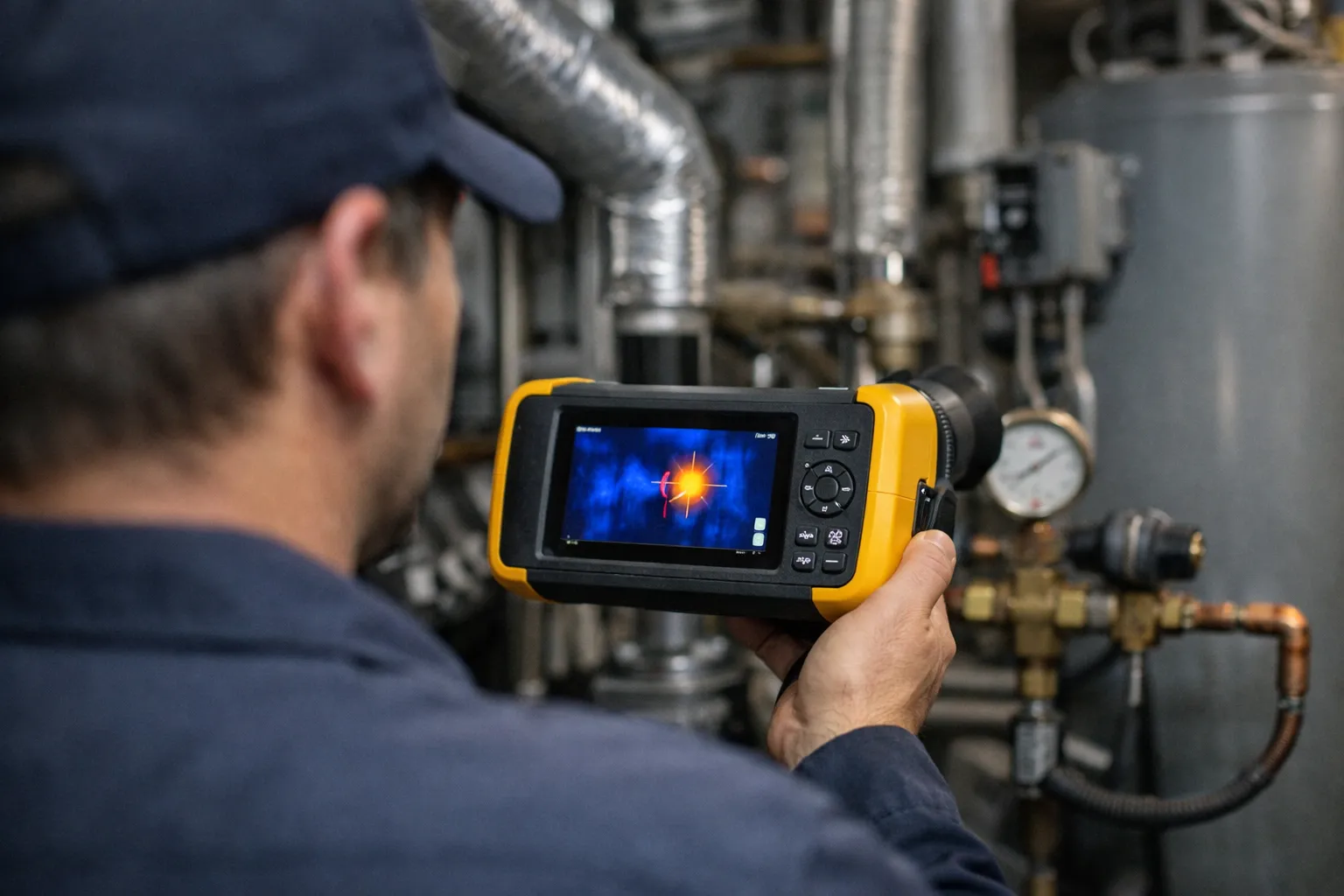
Acoustic leak detection has matured from a niche technique into a mainstream troubleshooting tool for HVAC technicians and system enthusiasts. In this review I put the Fluke ii900 Sonic Industrial Leak Detector through a series of real‑world HVAC surveys in 2025–2026: rooftop RTUs, packaged heat‑pump condensing units, split systems using lower‑GWP refrigerants and mechanical rooms with heavy background noise. The goal: assess how the ii900 changes survey speed, accuracy and decision‑making for field teams.
What the ii900 is and how it works
The Fluke ii900 is a handheld acoustic imaging device that uses an array of ultrasonic microphones to detect pressure‑driven sounds associated with gas leaks. It overlays a colorized "sound map" on an on‑screen camera view, letting the operator point and see probable leak locations. Because it detects sound rather than gas concentration, the ii900 is a different tool from traditional heated‑sensor sniffers or infrared cameras; it excels at narrowing a search area quickly.
Key features evaluated
- Acoustic imaging: real‑time heatmap overlay that identifies the direction and apparent intensity of ultrasonic sound sources.
- Directional audio: headphones let technicians hear amplified ultrasonic signals translated into the audible range.
- Handheld ergonomics: pistol‑grip form factor and touch display that can be used with gloves.
- Survey workflow: rapid scanning capability across coils, fittings and brazes without making physical contact.
- Data capture: the unit stores images and audio clips for reporting and later analysis.
Field performance — what I tested
My field tests covered several representative HVAC scenarios:
- Rooftop packaged units on a noisy roof (wind and adjacent fans).
- Split‑system mini‑splits with R‑32 and R‑410A condensers in residential yards.
- Mechanical rooms with multiple operating chillers, pumps and ductwork resonance.
- Close inspection of brazed service valves and flared fittings after repair work.
Across these contexts the ii900 consistently accelerated the search phase. On rooftop units it reduced the initial sweep time by roughly 50–75% compared with a methodical sniffer survey: instead of inching along panels and checking every potential leak point, I could scan broadly, spot a bright sound "hot spot" on the display, then zero in for verification.
In quieter locations the ii900 located leaks that were otherwise difficult to find with a basic sniffer—especially leaks that produced narrow‑band ultrasonic signatures (for example, a small pinhole in a brazed seam). In louder plantrooms the device was still useful but required closer proximity and a deliberate approach to separate mechanical noise from refrigerant leak signatures.
Sensitivity and limits
The ii900 detects acoustic signatures, not refrigerant concentration. That design gives it advantages and clear limits:
- Advantages: Fast non‑contact screening; able to find leaks behind insulation and in tight spaces where a probe can't go.
- Limits: Very slow leaks with negligible turbulence may be below the acoustic threshold; leaks masked by mechanical noises or turbulent airflow can be difficult to isolate; wind blowing across fittings can create false positives.
Because of these constraints, I always validated ii900 candidates with a secondary method: a calibrated heated‑sensor sniffer, nitrogen pressure drop test, or fluorescent dye for verification during repair. Treat the ii900 as a powerful triage and localization tool rather than a standalone certification instrument.
Pros and cons — practical takeaways
- Pros
- Rapid localization reduces survey time on large rooftop fleets and dense mechanical rooms.
- Non‑contact detection is safer and keeps technicians off ladders and away from hot surfaces longer.
- Visual outputs make it easier to document leak locations for clients and compliance logs.
- Cons
- Not a replacement for concentration‑based confirmation; always confirm with a sniffer or pressure test.
- Learning curve — interpreting sound maps in noisy environments requires practice.
- Cost and replacement considerations: it's an investment best justified by fleet‑scale leak‑finding needs or frequent complex surveys.
Suitability: who should buy one
The ii900 is especially valuable for:
- Service contractors and commissioning teams who routinely survey large numbers of units or complex plants.
- Facility engineers managing commercial portfolios with recurring refrigerant‑loss issues.
- HVAC enthusiasts who want a modern, efficient tool for troubleshooting and documenting leaks.
It is less compelling for small residential-only technicians whose business sees only occasional leak work, unless they want the speed and documentation benefits for higher‑value service calls.
How to integrate the ii900 into your workflow
- Start with a broad acoustic sweep to identify hot zones, then close in for visual inspection.
- Use headphones and slow the scan speed in noisy areas to avoid misattributing mechanical sounds.
- Follow every ii900 detection with a confirmation step: heated‑sensor sniffer, pressure decay test, or dye verification before billing or repair decisions.
- Document screen captures for client reports and warranty claims; the ii900's saved images help build evidence for refrigerant loss timelines.
Alternatives and complementing tools
No single tool covers all leak scenarios. For best results use the ii900 alongside:
- Heated‑sensor or IR‑based electronic leak detectors for concentration readings.
- Ultrasonic stethoscopes for targeted follow‑up in constrained spaces.
- Pressure‑test rigs and refrigerant recovery carts for repair verification and environmental compliance.
Verdict
On balance the Fluke ii900 is a transformative survey tool for HVAC professionals who need speed, documentation and improved first‑pass detection. It does not replace sniffers or pressure tests, but as a localization device it reduces time on site and directs expensive follow‑up testing where it will be most productive. For contractors and facility teams handling multi‑unit portfolios or complex plantrooms, the ii900 is an investment that pays back in time savings and better diagnostic certainty. For occasional residential users, evaluate whether the workflow and documentation benefits justify the cost; if your business aims to scale leak‑finding services, it belongs in the toolbox.
Practical final recommendation: purchase or rent one for a month and run it alongside your current methods. The difference in survey speed and client reporting will tell you whether the ii900 is a one‑time convenience or a new standard operating tool for your shop.