
Overview
As of August 2026, A2L refrigerants (mildly flammable, low‑GWP blends such as R‑454B and R‑32) are firmly in commercial HVAC product roadmaps and field workstreams. The technical viability is no longer the primary barrier; the finance, permitting and service‑model questions are. This update explains what has changed since spring 2026, provides fresh cost signals and code context, and gives owners and contractors an ROI‑focused roadmap for retrofit vs replacement decisions.
Background — why this still matters
The AIM Act and parallel international F‑gas rules continue to shrink future availability of high‑GWP HFCs, increasing the practical value of low‑GWP alternatives. ASHRAE and NFPA clarified A2L implementation language in 2024–2025; since then OEMs have launched A2L‑native lines and the supply chain has scaled. That progress reduces technical uncertainty, but it also shifts decisions onto capital budgets, permit timelines and long‑term servicing costs—areas where owners and contractors must make tradeoffs that can affect total cost of ownership for a decade.
Data & evidence — what’s new through August 2026
- OEM availability: All major commercial HVAC OEMs (for example, Daikin, Carrier, Trane, Mitsubishi Electric) now advertise A2L‑native options across packaged rooftop units, VRF/VRV and light commercial air‑cooled chillers. Most product lines shipping in 2026–2027 are designed as A2L‑first rather than aftermarket conversions, which improves warranty and certification clarity.
- Price and supply trends: Refrigerant pricing and cylinder availability stabilized through mid‑2026 relative to 2024–2025 volatility. Equipment premiums for A2L‑native units have narrowed: typical manufacturer list premiums in 2026 average in the single‑digit to low‑teens percent range versus legacy R‑410A platforms, depending on capacity and feature set.
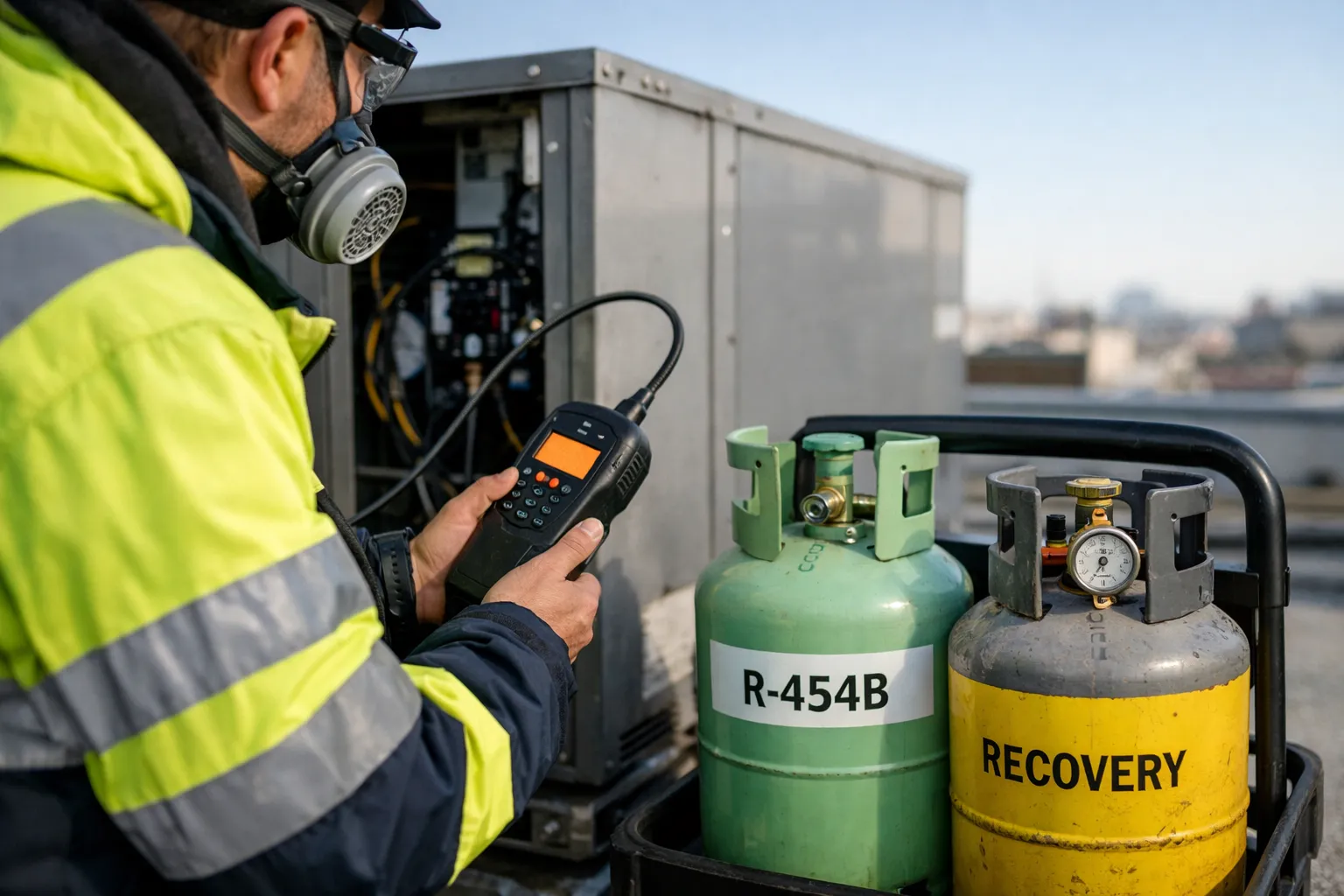
- Service economics: Intrinsically safe (IS) detectors and updated leak‑detection systems matured in 2025–2026. Per‑technician capital outlay has begun to decrease from early‑2026 highs as competition increased: realistic year‑one tooling ranges are now approximately $1,500–$6,500 per tech (detector class, IS toolset and ruggedization vary by vendor).
- Training uptake: Vendor and third‑party A2L curricula are standard; employers report training costs similar to prior estimates—roughly $800–$3,000 per tech for classroom and hands‑on validation—but many contractors now add supervised field mentoring hours before assigning techs to A2L work solo.
- Code adoption: Model code language clarified charge tables and detector/ventilation requirements in 2025–2026. Local adoption remains staggered: several states and many large municipalities have adopted the newer model language, while others retain older or amended rules. The result: permit complexity continues to be the single largest variable in project timing and cost.
Multiple perspectives — what stakeholders are saying
- Owners (capital planners): Facilities managers tell me they prefer replacement for systems older than 8–10 years to avoid the compounded cost of retrofit mitigation, future refrigerant scarcity and potential mid‑project AHJ demands. For smaller rooftop units that meet local charge thresholds, retrofit remains attractive for near‑term capital constraints.
- Contractors: Progressive contractors see A2L as a growth area—provided they model realistic payback for IS tools and training. Many emphasize the need to price the permit risk explicitly in bids and to require OEM approval letters as a condition of work.
- Insurers and risk managers: Underwriters have formalized expectations in many markets: written OEM confirmation of conformity for the specific application, documented technician qualifications, and continuous detection plus maintenance plans for systems over certain charge sizes.
- Manufacturers: OEMs promote integrated A2L features—factory‑installed leak detection, optimized charge control and built‑in ventilation interfaces—to reduce field add‑ons and simplify permitting conversations with AHJs.
Costs, retrofit vs replacement — updated practical numbers
Decisions still hinge on asset age, occupancy, and local code. Updated cost signals for August 2026:
Retrofit scenarios — what to expect
- Feasibility: Factory‑approved conversion kits exist for a subset of modern units; where available they reduce engineering time but usually do not eliminate requirements for room ventilation, continuous detection or electrical changes.
- Typical cost delta: Comprehensive retrofit packages—including refrigerant, components (expansion devices, filter driers), commissioning and safety upgrades—now commonly add roughly 10–28% to a non‑A2L service scope. The wide range depends on ventilation, structural work and AHJ demands.
- Hidden costs and timeline risk: Permit review windows and AHJ requests for manufacturer letters or system drawings can add weeks and several thousand dollars. Budget a contingency line (commonly 5–12% of project cost) for permit and compliance friction.
Full replacement scenarios — lifecycle perspective
- Upfront premium: A2L‑native equipment premiums continue to compress; expect 3–12% added upfront cost on many 2026 commercial SKUs compared with legacy R‑410A platforms, though integrated features in new units reduce field add‑ons.
- Lifecycle ROI: For systems in midlife (roughly 7–12 years), replacement often becomes economically preferable when you factor in likely HFC scarcity/price risk, potential future retrofit mandates, improved efficiency, and reduced permit uncertainty—particularly for critical facilities or high‑occupancy buildings.
Service market realities — operational guidance
- Tooling and capital planning: Update service budgets to include IS detectors, intrinsically safe hand tools and calibration costs. Use a multi‑year amortization model tied to projected A2L job volume—not vendor sales decks—to calculate technician payback.
- Training and competency: Budget for formal training plus supervised field hours. Maintain documented competency records and include them in permit submissions where required. Plan for periodic refresher training tied to equipment or code changes.
- Monitoring and maintenance: Continuous detection plus a documented sensor calibration and maintenance schedule materially reduces insurer friction. For many systems, quarterly or semiannual sensor checks provide a reasonable balance of safety and cost; calibrate detectors per manufacturer guidance.
Insurance, procurement and contract changes
Insurers increasingly require explicit documentation. Practical procurement changes to adopt now:
- Include a requirement for OEM approval letters and reference to specific model numbers in contracts and RFPs.
- Require contractors to provide proof of technician A2L competency and a sensor maintenance schedule in bids.
- Negotiate who maintains continuous detectors and responds to alarms—owners should avoid ambiguous warranty language that shifts long‑term detection duty without compensation.
Best‑fit commercial applications (August 2026)
- Good fit: Small‑to‑medium packaged rooftop units, ducted split systems and VRF installations where charge sizes stay within local code limits and ventilation can be provided without major structural work.
- Conditional fit: Medium buildings where monitoring and mechanical room ventilation are economically feasible; evaluate replacement when systems are older than 8–10 years.
- Poor fit: Very large central plants, high‑occupancy assembly spaces with strict charge limits, and critical facilities that prefer non‑flammable alternatives (CO2, ammonia) for safety or operational reasons.
Practical, ROI‑focused recommendations (updated)
- Perform a risk‑weighted audit: Map age, refrigerant type, charge sizes, occupancy and likelihood of AHJ mitigation. Include a permit‑timing risk score that adjusts project contingency and cashflow forecasts.
- Secure OEM letters early: Don’t assume verbal approvals. Get written approval that ties into warranty language before specifying retrofit materials or labor.
- Price permit and insurer risk explicitly: Add separate line items for ventilation upgrades, detection systems, permit management and insurer documentation to make bids transparent and avoid post‑award claims.
- Amortize tooling by realistic pipeline: Contractors: amortize IS tool costs over forecasted A2L jobs and adjust labor rates until payback is clear.
- Use monitoring to de‑risk: Specify continuous detection with documented calibration and an alarm‑response SLA in service agreements. Consider third‑party verification for high‑risk assets.
Implications — who gains and who should be cautious
Contractors who price permit and insurer risk accurately and invest prudently in training, IS tooling and monitoring will capture the growth in A2L work. Owners who fold A2L planning into five‑year capital cycles avoid rushed conversions that inflate costs. But adoption will remain patchy across jurisdictions—A2L is a practical decarbonization route for many applications, but not the universal solution.
Outlook — what to watch for next
- Further municipal adoptions of updated model codes will reduce uncertainty—monitor state building code amendments and key municipal AHJ guidance.
- Detector and IS‑tool standardization should continue to reduce per‑tech capital costs over 12–18 months as certification schemes align.
- Equipment premiums should compress as A2L becomes the baseline option for new commercial SKUs; owners should track manufacturer roadmaps and total installed cost comparisons for upcoming purchasing cycles.
FAQ — common questions owners and contractors are asking now
Can I convert an existing R‑410A rooftop to an A2L refrigerant?
Possibly, but only for certain platforms. If the OEM offers a factory‑approved conversion kit and provides a written approval letter, conversions are feasible. Expect added costs for continuous leak detection, possible ventilation and electrical changes. Confirm AHJ acceptance before contracting work.
How much should I budget to make my service techs A2L‑ready?
Plan for roughly $2,300–$9,500 in year‑one per technician: $800–$3,000 for training plus $1,500–$6,500 for IS detectors and specialty tools. Exact numbers depend on the detector class, equipment choices and whether in‑house mentoring covers supervised field hours.
Will insurers refuse coverage for buildings using A2L refrigerants?
Not generally, but many insurers now require documentation: OEM installation confirmation, technician qualifications, and continuous leak‑detection plus maintenance plans for larger charge systems. Get insurer requirements in writing during project scoping to avoid surprises.
Is A2L the right long‑term choice for large central plants?
Not always. For very large plants or industrial settings, non‑flammable low‑GWP options such as CO2 or ammonia may deliver better lifecycle economics and fewer charge‑related safety constraints. Evaluate by scale, occupancy risk and total cost of ownership rather than defaulting to A2L.
What immediate steps should owners take now?
Inventory refrigerant type and age, require OEM letters for any retrofit work, confirm insurer expectations, and include continuous detection and calibration schedules in service contracts. If a major replacement is within 5–7 years, factor A2L readiness into capital planning now to avoid rushed, costly conversions later.
Bottom line: By August 2026, A2L refrigerants are mainstream across many commercial HVAC product lines—but successful, cost‑effective adoption depends on honest budgeting for permit and insurer friction, clear OEM documentation, and investment in training, IS tools and monitoring. Consider your asset ages, occupancy types and risk tolerance carefully before deciding retrofit vs replacement.