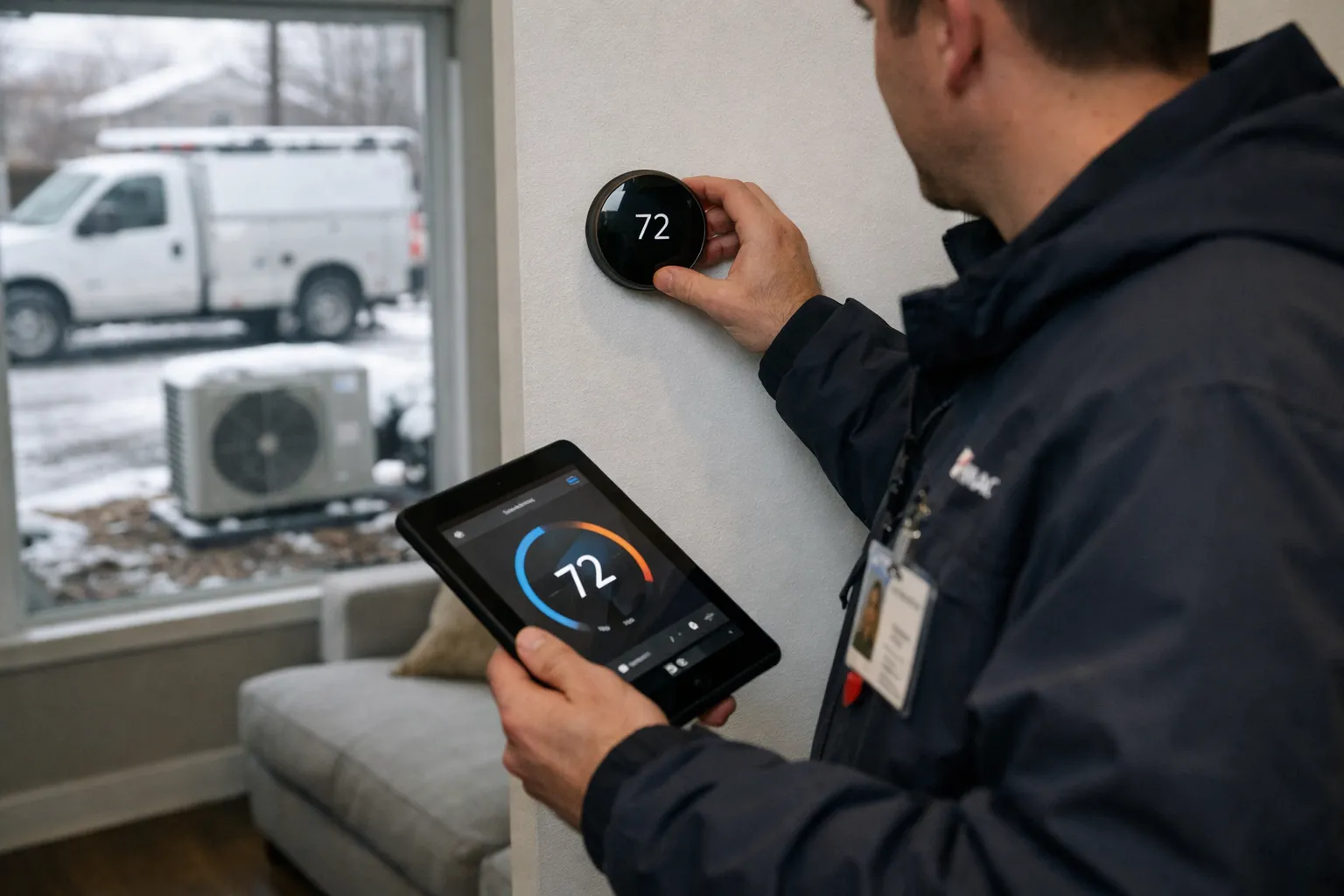
Across the Northeastern United States, two parallel trends that had been quietly accelerating for several years—wider deployment of time‑of‑use (TOU) electricity tariffs and large‑scale enrollment of connected smart thermostats—reached a tipping point in 2024–2026. The result is a materially different winter load shape for residential and small‑commercial HVAC systems. This analysis examines how those rate and control changes altered peak timing and magnitude, what the data imply for heat‑pump sizing and control strategies, and how installers, manufacturers and utilities should adapt.
What changed: tariffs, devices and enrollment
Since 2023, major Northeast utilities expanded TOU or real‑time pricing offerings for residential customers and pilots broadened to include small commercial accounts. Con Edison, state utility commissions in Massachusetts and New York, and regional pilot programs rolled out more granular winter hours and steeper on‑peak premiums intended to shift load away from late‑afternoon and early‑evening peaks.
At the same time, smart‑thermostat penetration—led by brands that partner with utilities for demand‑response programs—crossed a scale threshold. Utility‑administered programs and aggregator platforms enrolled hundreds of thousands of connected thermostats across the region by 2026. Those devices are now actively managing heating setpoints and runtime during critical grid events, either through utility signals, third‑party aggregators, or locally executed algorithms that respond to price signals.
Observed load‑shape effects
The combined effect of steeper TOU differentials and thermostat control was twofold:
- Temporal shift in peak demand. Where winter residential peaks historically concentrated in the late‑evening hours when occupants returned home and raised thermostats, many networks now exhibit a pronounced earlier peak driven by pre‑heating behavior—customers or thermostats increasing temperature ahead of expensive on‑peak windows, then holding back during the peak.
- Reduced sustained peak magnitude but higher ramp rates. Smart control and preheating compress aggregate demand during the defined on‑peak period, lowering the sustained plateau of load. However, several pilot evaluations recorded quicker load ramps immediately before on‑peak intervals—an operational challenge for grid balancing and for HVAC equipment stress.
These patterns are consistent across utility territories that paired meaningful price signals (large on/off differentials or real‑time price exposure) with thermostat enrollments and automation incentives.
Implications for heat‑pump sizing and backup systems
For installers and designers, the new load profile has multiple practical implications:
- Sizing for worst‑case vs. operational reality. Historically, designers sized heat pumps conservatively to meet concurrent worst‑case heat loads including evening occupancy peaks. With preheating and scheduled setback behavior now common, average operational capacity utilization has shifted downward. That argues for closer consideration of performance metrics across an hour‑by‑hour distribution rather than a single design‑day peak.
- Cold snaps remain binding. The fiscal and comfort benefits of TOU‑driven load shifting disappear during prolonged extreme cold when preheating cannot substitute for continuous capacity. Installations must still plan for those events: maintaining appropriately rated auxiliary heat (or designing for hybrid fossil/electric operation where permitted) and ensuring control strategies do not leave occupants vulnerable during price spikes.
- Compressor cycling and ramp stress. Fast preheat ramps produced by thermostats can increase compressor cycling or push inverter‑driven compressors into aggressive modulation patterns. That has maintenance and warranty implications—installers should verify minimum run times, anti‑short‑cycle protections and encourage staggered preheat schedules when aggregating multiple thermostats in a building.
Controls and commissioning: what works
Several control strategies consistently reduced customer bills while preserving comfort and grid stability in field trials:
- Staggered pre‑heat windows: Aggregators or utility programs that randomize preheat start times across participating homes reduce the pre‑peak ramp and smooth aggregate demand.
- Adaptive setback limits: Thermostats that adapt setback depth based on outdoor temperature and building thermal envelope maintain comfort with minimal on‑peak usage. For heat‑pump systems, supply‑temperature or staging logic that anticipates inverter modulation limits performs better than simple setpoint changes.
- Critical event override: Provide users with a manual or automated override to preserve comfort during cold emergencies; transparent opt‑out policies increase program participation.
From a commissioning perspective, technicians should verify the thermostat's integration with the heat pump: confirm that demand‑response signals do not disable critical protections (defrost cycles, high‑pressure safeguards), and that firmware is up to date. Documenting preheat schedules and factory defaults in the service report helps future troubleshooting.
Market and business dynamics
These behavioral and operational shifts are reshaping market conversations:
- Value streams for installers: utilities and aggregators increasingly pay for enrollment and performance. Installers who bundle smart thermostat deployment and offer aggregation management can open new revenue streams—installation incentives + recurring aggregator integration fees.
- Product differentiation for manufacturers: heat‑pump OEMs are optimizing inverter algorithms and control APIs for smoother ramping and better integration with third‑party thermostats. Models that expose richer telemetry (supply temp, compressor modulation state, energy use) command a premium in commercial and multifamily segments.
- Role of on‑site storage and hybrid systems: Where TOU spreads are wide, pairing modest thermal storage (water‑tank or phase‑change) or electrical storage with heat pumps enables more aggressive preheating while mitigating rapid ramps and providing resilience during cold snaps.
Regulatory and utility considerations
Regulators evaluating TOU expansions should weigh three tradeoffs evident from recent pilots:
- Equity: Households without smart thermostats or with incompatible heating systems face different bill impacts. Programs need low‑income enrollment paths and pre‑approved hardware subsidies.
- Grid reliability: Smoothing pre‑peak ramps requires coordination—utilities and aggregators should share baseline forecasts and orchestration signals.
- Transparency and data access: Public reporting of program performance (peak reductions, ramp characteristics, customer complaints) helps productively steer program design without relying solely on vendor claims.
Recommendations for practitioners
For HVAC contractors, fleet managers and system designers working in the Northeast in 2026:
- Assess the customer’s tariff structure early. TOU exposure changes both economics and control choices; size and control for the customer’s actual billing profile, not a generic rate.
- Install smart thermostats with open APIs and proven utility integration. Negotiate enrollment details and obtain documentation about expected preheat behavior and opt‑out rules.
- Include anti‑short‑cycle and minimum‑run protections in initial commissioning, and record these settings on handover documents.
- For multifamily and aggregated portfolios, coordinate preheat schedules to avoid synchronized ramping—use building management systems or aggregator platforms to distribute preheat windows.
- Offer optional resilience packages—thermal storage, larger buffer tanks, or hybrid backup—to customers with critical comfort needs or high exposure to TOU peaks.
Conclusion
Time‑of‑use tariffs and the rapid penetration of smart thermostats have already changed the operational reality for many Northeast HVAC systems. The key takeaway: average usage has become more price‑sensitive and temporally redistributed, but the engineering imperative to plan for cold snaps and equipment stress remains. Installers and manufacturers who adapt controls, commissioning practices and product offerings to this new load geometry will capture energy‑saving opportunities for customers while supporting grid stability.